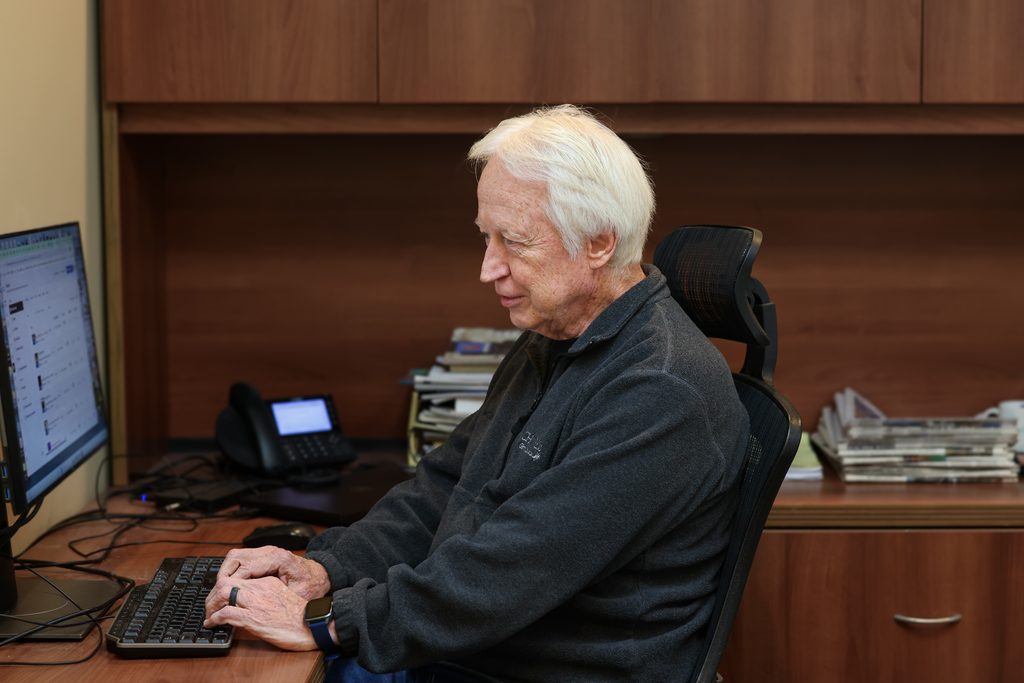
Few high school students know exactly what they want to do with their lives. Al Edenloff is an exception.
His newspaper-reporting career began in 10th grade, covering local sports for the Parkers Prairie Independent. He’s still at it more than four decades later – that spark of curiosity about the people and events around him that took light as a teenager continuing to drive him and shape his work.
As editor of the Echo Press since 1990, Edenloff has spent much of his life telling Alexandria’s stories, from helping people understand the impact of local government actions, to providing the information they need to make decisions during elections, to giving insight into the people who call Douglas County home.
We talked about his path into journalism, what keeps him motivated and the changes he’s experienced along the way.
Tell me about your career path, from the Parkers Prairie Independent to the Echo Press.
I began writing for the Parkers Prairie Independent in 10th grade. I still remember my first story, a feature about referees at high school basketball games. I called it “The Men in Black and White.”
At Moorhead State University, I studied mass communications and print journalism and worked for the student newspaper, The Advocate. An internship at the Echo Press led to a full-time reporting position after I graduated in 1984.
Early on, I covered both sports and news and learned a great deal from Larry Holverson. He’s a legend at the paper known for his knowledge of local athletes and great sense of humor. While I enjoyed sports, I was increasingly drawn to news and understanding what was happening throughout the community.
In 1990, the same year Forum Communications purchased the Echo Press, I became editor.
You’ve dedicated more than 40 years to local journalism. What continues to motivate you and make this work meaningful?
For me, it’s informing the public. We want to report quickly and accurately, then develop the story further and provide the context people need to better understand the issue.
An hourlong city council meeting can provide enough material for several stories, but it’s up to us to organize the information and provide readers the context they need to understand how it affects them.
Over the years, you build institutional knowledge — familiarity with the community, its places and the history behind an issue — that you bring to your reporting. I think that’s important.
Hearing from readers makes the work meaningful. Sometimes people stop me at the grocery store to tell me about something they liked in the paper. I love that.
We recently held a reader forum at the public library, where 120 people attended to share their feedback. Through those conversations and our reader surveys, we learn what people value most about the paper.
What are the most significant changes you’ve experienced in local journalism?
The amount of information available is one of the biggest changes. Early in my career, for example, I was working on a story about the Vietnam War. Finding out when it started meant driving to the library and looking it up. There was no Google.
Today, social media can lead us to stories we might not otherwise hear about and help us identify people to contact. But we still have to verify the information because people expect what they read in the paper is accurate; credibility is the key.
How we deliver stories has changed, too. We had one of the first newspaper websites in the state. The big papers were first, but we did pretty well at keeping up. Now we use video to enhance our reporting, particularly in sports. A short clip from a game adds something to support the coverage.
Staffing has changed significantly. At our peak, we had around 40 people across the newspaper. Now we’re down to about 15. We once had three people covering sports, two running the lifestyle section and a dedicated photographer. Today, we have one dedicated sports reporter, no dedicated lifestyle reporters and no dedicated photographer.
It’s hard to see papers losing people, but we have to find ways to strengthen ourselves. As I tell people, “We may be small, but we’re mighty.”
What role does professional journalism play in building an informed, connected and engaged community?
Accuracy is the main thing. People sometimes try to break news on social media before we do, but they don’t always have the facts. I remember a case where people were saying someone had died when he was still alive. We have to do the research, contact the people involved and provide the background readers need to understand the story.
Our voter guide is a good example of our role. I developed questions for the candidates, giving them an opportunity to explain their positions and providing readers with information they might not otherwise have in that depth.
Following up is another important responsibility. Readers have told us in surveys that they appreciate when we return to stories. We might publish 10 or 12 updates on a single court case. People want to know what happened, and we try to make sure they have that information in a timely manner.
According to a 2026 State of Local News report, 170 newspapers closed or merged in the past year, and nearly 47 million Americans have limited or no access to local news. What do you see as the greatest challenges and opportunities for local journalism, and what can communities do to support its future?
Staffing is one of our biggest challenges. With fewer people covering the news, we can’t do everything we once did. Readers notice the difference, and losing them is hard.
But I get frustrated with the idea that nobody reads newspapers anymore. We have a strong base of supporters who value local journalism.
The simplest way to support us is to subscribe and spread the word because word of mouth can make a big difference.
Local organizations can also help by sharing accurate, timely information and connecting us with people who can provide additional context. We receive a lot of news releases, and quality matters. We need information we can trust and sources we can contact. We still verify the facts, use proper attribution and do our own reporting, but having reliable information to start with helps.
About the Author
Kimberly Albert, APR, MA, is a public relations consultant with more than 20 years of experience helping organizations strengthen visibility, clarity and trust in an evolving media landscape. On this blog, she shares perspectives on public relations, communications and journalism in central Minnesota. To learn more about public relations services for your organization or recommend a noteworthy person or project for a profile, get in touch.