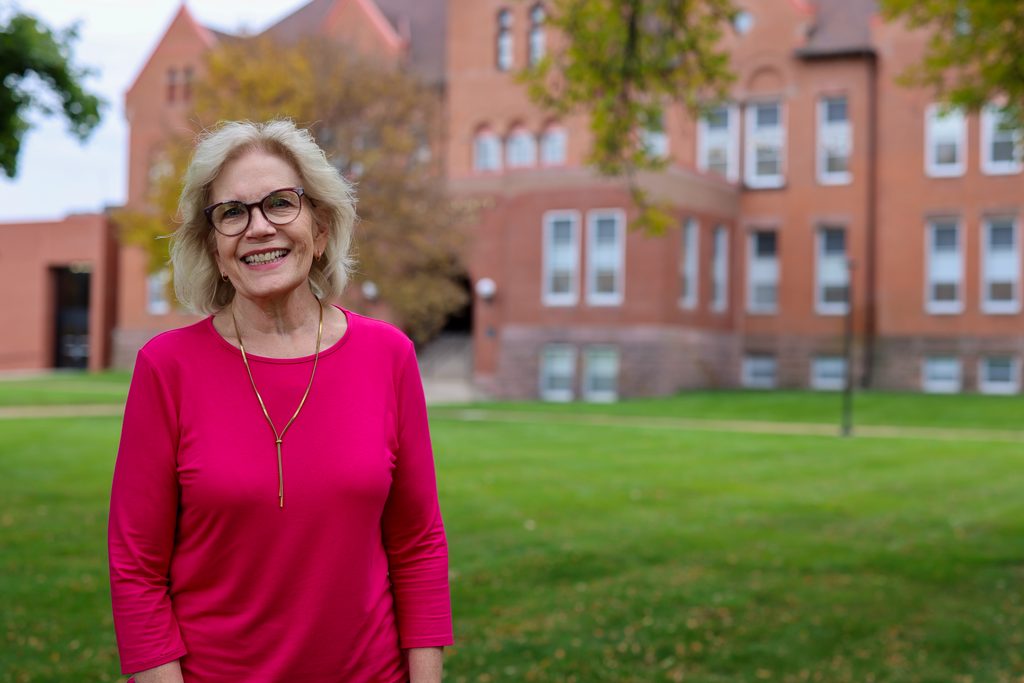
From television newsrooms to state and county government, Julie Anderson has spent more than four decades telling stories, sharing information and serving communities.
As Douglas County’s public information officer and emergency manager, she draws on 25 years in television journalism and nearly 15 years in public service. Now, as a candidate for county commissioner, she’s looking to bring that experience to a new leadership role.
Throughout her career, one principle has remained constant: Listen first.
Tell me about your career path, from studying journalism to working as a TV producer and public information officer.
I fell in love with journalism in high school, thanks to a reporting class with Mrs. Bruchman. I’d always loved reading and writing, but that class showed me how to combine those interests with telling people’s stories.
I first understood the responsibility that comes with telling someone’s story when a classmate trusted me with her experience following an accident. She shared what had happened and allowed me to tell her story. That experience stayed with me. It showed me that people are willing to trust journalists with deeply personal moments, and that we have an obligation to listen carefully, get the facts right and portray their experiences accurately.
After graduating from the University of Minnesota’s journalism school, I began my career at KCMT-TV in Alexandria, producing the 6 and 10 o’clock news. From there, I worked as a reporter in Duluth and Green Bay before moving into investigative journalism at WCCO, KSTP and KMSP in the Twin Cities.
A 25-year career in television news eventually led to public service, beginning as communications director for Hennepin County Sheriff Pat McGowan, then as a public information officer with the Minnesota Department of Public Safety and, for the past nine years, as Douglas County’s public information officer and emergency manager.
What brought you to Douglas County as its first dedicated public information officer and emergency manager?
Alexandria has held a special place in my heart since I started my journalism career here, and I’d always hoped to return.
I first met Sheriff Troy Wolbersen at an effective communication class while he was serving as Douglas County’s emergency manager and I was working at the Minnesota Department of Public Safety. We stayed in touch.
Through his conversations with county commissioners, the need for a dedicated public information officer became clear, leading the county to create a position combining emergency management and public information.
Having earned my emergency management certification while working for the state, I felt the position was a natural fit for my background and experience. The two responsibilities complement each other. When I’m not responding to an emergency, I’m helping residents understand what’s happening in county government, whether it’s a road project, a new facility or an important decision by the county board.
I can always find stories to tell, and I love doing that.
Having worked in both the Twin Cities and central Minnesota, what differences have you noticed in how organizations approach communications?
In the Twin Cities, organizations generally understand that when something happens, whether positive or negative, the news media will show up. They’re prepared for it, and they’ve trained for it.
In central Minnesota, having the news media come can sometimes be viewed as a burden rather than an opportunity.
That’s unfortunate because the media can be one of our greatest resources, particularly during emergencies when we need to reach as many people as possible, as quickly as possible.
At the same time, local journalism has changed dramatically. Newsrooms have shrunk, and reporters are being asked to cover more stories with fewer resources. That makes other channels and community partnerships increasingly important.
I’ve developed a joint information system that brings together organizations and community partners, including local Facebook groups, to help amplify important messages.
Those relationships proved valuable during COVID, following the tornadoes and during the natural gas emergency.
People are more likely to act on information when it comes from someone they know and trust. During the natural gas emergency, for example, the mayor helped communicate important information through her Facebook page. That local connection and authority made a difference.
Reaching everyone remains a challenge, especially when you consider differences in age, income and access to technology. Sometimes social media works best. Sometimes it’s a printed resource guide.
There’s no one-size-fits-all solution. That’s why trained communications professionals and strong community partnerships are so valuable.
How has your background in journalism and communications influenced your approach to leadership and your decision to run for county commissioner?
My career in journalism taught me the importance of asking questions, listening and understanding different perspectives before making decisions. Those skills have been just as valuable in public service.
As Douglas County’s public information officer, I regularly attend county board meetings. I’ve learned how decisions are made, the challenges commissioners face and the many organizations and stakeholders involved in serving our communities.
The relationships I’ve developed have given me a deeper understanding of the issues affecting Douglas County and the people who live here.
County commissioner is a nonpartisan, part-time position, but it carries enormous responsibility as we shape the future of Douglas County.
Ultimately, I want to be part of an effort where we can look our grandchildren in the eye and say, “You know what? We did our very best.”
What advice would you give communications professionals working in central Minnesota?
Listen first.
When organizations have a story to tell, it’s tempting to jump right into sharing information. But if you don’t take the time to listen to people, you’re not fully understanding the issue.
Recently, I attended a public meeting about deer hunting regulations in Douglas County. The room was filled with residents who had done their research and came prepared to share thoughtful, compelling perspectives.
I learned so much simply by listening.
The same principle applies to communicating about county services. We might invest in developing a wonderful new GIS map, for example, but if residents don’t know it exists or understand how to use it, we’re missing an important step.
Listening helps us recognize those gaps and find better ways to serve people.
My advice to anyone entering the communications profession is to take time to listen to people and understand how issues are affecting their lives.
You’ll get a much better story.
About the Author
Kimberly Albert, APR, MA, is an award-winning public relations consultant with more than 20 years of experience helping organizations strengthen visibility, clarity and trust in an evolving media landscape. On this blog, she shares perspectives on public relations, communications and journalism in central Minnesota. To learn more about public relations services for your organization or recommend a noteworthy person or project for a profile, get in touch.